


Bill of Quantities Meaning: A Practical Guide for GCs and Subs
Bill of Quantities Meaning: A Practical Guide for GCs and Subs
Ever had a bid meeting grind to a halt because someone caught an error in the projected costs? Maybe a labor rate didn’t match the BOQ. Or someone spotted a duplicate line item. I've been there—it’s frustrating, time-wasting, and worst of all, it can cost you the job. That’s where a clear, accurate Bill of Quantities (BOQ) becomes indispensable.
If you’re a general contractor (GC) or a subcontractor (sub), you’ve probably come across the term "BOQ" countless times. But let’s be honest: how many of us have wrestled with a poorly constructed BOQ, only to wonder if the whole thing could have been done better, faster, and with fewer headaches?
It can, and I’ll show you how. But first, let’s break it down.
What Is a Bill of Quantities (BOQ)?
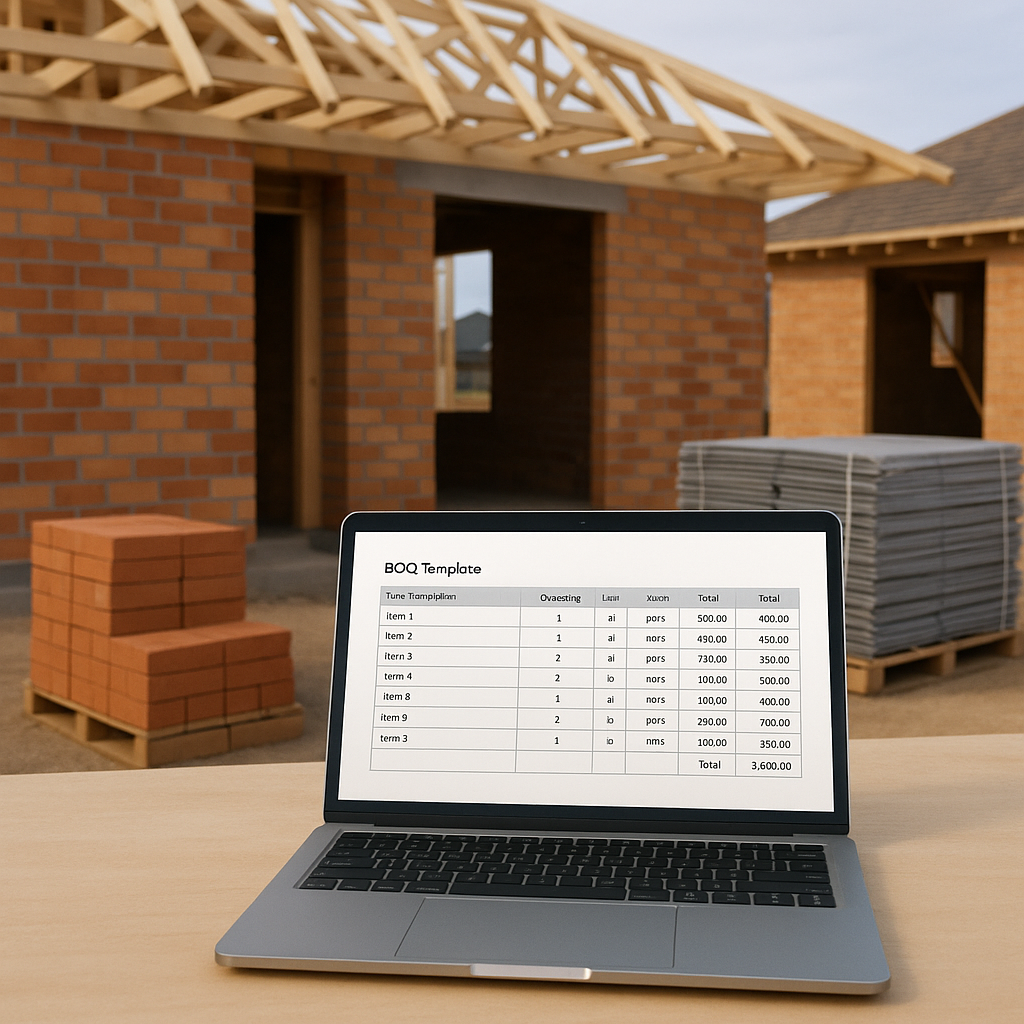
A Bill of Quantities (BOQ) is a structured document listing every item of work required for a construction project, along with its associated quantities, units, and rates. Think of it as the detailed shopping list for your project, but with labor and equipment costs baked in.
Typically, a BOQ includes:
- Item descriptions: What’s being built or installed, broken down into clear, actionable tasks.
- Quantities: The amount of work to be done, measured in standardized units (e.g., cubic meters of concrete, linear meters of ductwork).
- Units: Measurement types (e.g., m² for tiling, tons for steel reinforcement).
- Rates: Unit costs, often split into material, labor, and equipment components.
- Totals: Line-item extensions (quantity x rate) and project-wide sums.
The purpose? To standardize project costs, ensure apples-to-apples comparisons between bids, and reduce disputes later. According to Designing Buildings Wiki, BOQs are often prepared as part of tender documentation issued to contractors to obtain pricing for projects.
Actionable Steps to Build a BOQ
- Break Down the Scope of Work: Start with the project specifications and drawings. Ensure every task and material is accounted for. Missing items now could lead to costly change orders later.
- Measure Quantities Accurately: Use standardized units and measurement methods (e.g., NRM2 or CSI MasterFormat). This ensures consistency and reduces disputes.
- Assign Correct Rates: Research current market rates for materials and labor. Use rate books like RSMeans (widely used in the United States) or CPWD DSR (India) if applicable to your region.
- Create a Logical Structure: Group related work into sections (e.g., excavation, concrete, HVAC). This makes the BOQ easier to read and analyze.
Why Is a BOQ Important in Construction?
Imagine you’re a GC bidding on a high-stakes project. You’ve got subs submitting bids for their scope of work, and your client is asking for a fixed-price contract. Without a BOQ, how do you even begin to ensure that everyone is on the same page?
Here’s how a BOQ keeps things in check:
- Transparency: With a detailed BOQ, everyone—clients, consultants, contractors, and subs—has access to the same set of numbers. No hidden costs or vague estimates.
- Standardization: A good BOQ ensures that bids from different contractors are directly comparable. For example, if one sub quotes $250,000 for HVAC and another quotes $220,000, you can quickly check if both included ductwork installation.
- Error Reduction: A well-prepared BOQ minimizes the risk of missing scope items or double-counting costs. This cuts down on costly change orders.
- Budget Accuracy: When done right, a BOQ gives owners and contractors a realistic view of project costs, avoiding lowball bids that explode during execution.
A Real Example From India
In India, the CPWD DSR (Central Public Works Department Schedule of Rates) is often used as a benchmark for BOQs. These standardized rates help ensure that government projects across the country follow a consistent pricing model, reducing disputes and ensuring fair pricing.
Pro Tip: Regular Reviews
Many contractors skip periodic reviews of their BOQ. Don’t. Mistakes compound over time. Set aside 30 minutes to cross-check quantities, compare rates, and ensure no line items are missing or duplicated.
Types of Bills of Quantities
Not all BOQs are created equal. The type you need depends on the project and its phase. Let’s look at a few common types:
- Preliminary BOQ: Used during early project planning to provide a ballpark estimate. It’s light on detail and heavy on assumptions.
- Detailed BOQ: This is the gold standard for tendering. It includes a comprehensive breakdown of every work item, often tied to specific measurement standards like CPWD DSR (India), NRM2 (UK), or CSI MasterFormat (US).
- Provisional BOQ: Includes items that are uncertain or likely to change, allowing flexibility during execution.
- Measured BOQ: Prepared post-design, based on actual quantities from finalized drawings and specifications.
Comparison Table: BOQ Types
| BOQ Type | Use Case | Level of Detail | Flexibility |
|---|---|---|---|
| Preliminary BOQ | Early planning and feasibility | Low | High |
| Detailed BOQ | Tendering and bidding | High | Low |
| Provisional BOQ | Projects with unknown variables | Medium | Medium |
| Measured BOQ | Post-design, execution phase | High | Low |
Each type has its place, but the detailed BOQ is where most GCs and subs spend their time—and it’s where mistakes are most costly.
How BOQs Are Prepared: Traditional vs. Modern Methods
Traditional BOQ Preparation
Old-school BOQ preparation is a grind. It usually looks something like this:
- Print out the project drawings.
- Manually measure quantities using a scale ruler or software like Bluebeam.
- Cross-reference rates in massive rate books like RSMeans (US) or CPWD DSR (India).
- Enter everything into an Excel sheet, tab by tab, with formulas that are one accidental keystroke away from disaster.
Sound familiar? It’s not just slow—it’s risky. A single error in your spreadsheet can ripple through the entire estimate. And when you’re pulling rates from outdated PDFs or guessing at inflation factors, the final numbers are often wrong before you even submit the bid.
Modern BOQ Preparation with AI Tools
This is where tools like EstimateNext come in. Here’s how AI changes the game:
- Automated Quantity Takeoff: Instead of spending 40 hours measuring drawings, AI-powered tools like EstimateNext’s Vision AI extract quantities from PDFs in just 10 minutes. It’s not just faster—it’s also more accurate.
- Rate Matching: Forget flipping through 2,000-page rate books. EstimateNext uses AI to match BOQ line items to a database of 78,000+ SOR items in seconds.
- Real-Time Updates: Need to adjust a rate for inflation or swap materials? AI tools propagate changes throughout the BOQ instantly, with a full audit trail.
Actionable Steps for Modern BOQ Preparation
- Choose the Right Tool: Opt for AI-based platforms like EstimateNext for faster, error-free BOQs.
- Upload Project Documents: Most tools allow you to upload drawings, specifications, and rate books directly.
- Verify Output: While AI tools are precise, always cross-check critical items for accuracy.
Common BOQ Mistakes (And How to Avoid Them)
- Duplicate Items: Check for overlapping tasks. AI tools can flag these automatically.
- Rate Mismatches: Ensure your rates are current. AI-powered rate lookups eliminate guesswork.
- Version Chaos: Use a single, standardized BOQ template to avoid inconsistencies.
- Overcomplicated Formats: Keep it simple. Too many tabs and nested formulas invite errors.
Final Thoughts
A BOQ isn’t just a document—it’s a critical tool for managing construction projects efficiently and profitably. Whether you’re a GC or a sub, getting it right can make the difference between winning a bid and burning hours on rework.
If you’re tired of wasting time on manual BOQ prep, EstimateNext can help. Upload your first BOQ and see the difference AI makes. Get started free →
Learn more at JobNext.ai - Construction ERP
Put this into a real BOQ
Describe your project and get a complete, costed Bill of Quantities in about a minute — free to start.