


7 Cost Estimation Methods for Construction Projects in 2026
Why Accurate Cost Estimation Matters in 2026
Construction projects are becoming larger, faster-paced, and more competitive. Accurate cost estimation is the backbone of any successful project. Mistakes in this area can ripple through the entire process, from bid decisions to execution. So, how do you get it right?
Here are seven methods to keep your estimates sharp in 2026, leveraging both traditional practices and modern tools.
1. Classify Estimates by Their Level of Accuracy
Cost estimation isn’t one-size-fits-all. The industry uses five classes of estimates, ranging from rough guesses (Class 5) to detailed, data-backed projections (Class 1). Each class represents a different level of accuracy and effort required.
- Class 5: Rough order of magnitude (ROM) estimates. These are often used in feasibility studies or early-stage planning and have an accuracy range of -50% to +100%.
- Class 4: Preliminary estimates, typically used for conceptual design. Accuracy improves to -30% to +50%.
- Class 3: Budgetary estimates. These are the most common for bidding purposes and have an accuracy of -20% to +30%.
- Class 2: Definitive estimates, used during the pre-construction phase. Accuracy is tight at -15% to +20%.
- Class 1: Control estimates. These are prepared during execution and offer the highest accuracy, ranging between -10% to +15%.
Actionable Steps:
- Define the purpose upfront: Clearly identify whether the estimate will be used for bidding, budgeting, or execution. Misalignment here can lead to wasted effort or inaccurate projections.
- Use historical project data: Leverage data from past projects to refine accuracy in Classes 3–1. Tools like construction management software can centralize this data for easy access.
- Train your team: Ensure your team understands the differences between estimate classifications and their appropriate applications. For example, a Class 3 estimate should not be treated as definitive.
- Reassess estimates over time: As project details solidify, refine your estimates to move them closer to Class 1 accuracy. This iterative approach reduces risks as the project progresses.
2. Use AI for Drawing Takeoffs
Manual takeoffs can be time-consuming and prone to errors. AI-powered solutions are transforming this process by automating the extraction of quantities from drawings. These tools can scan PDF drawings and identify elements like room areas, wall lengths, and counts of doors or windows.
AI tools also reduce the cognitive load on estimators, allowing them to focus on high-level analysis rather than repetitive tasks like counting and measuring.
Actionable Steps:
- Choose the right AI tool: Platforms like Togal.AI or PlanSwift are popular options for automated takeoffs. Evaluate their features based on your project needs, such as the ability to handle specific file formats or integrate with your existing software.
- Verify output: While AI tools are accurate, cross-checking results ensures you catch nuances like unusual project specifications or non-standard designs.
- Integrate with existing software: Many tools can sync with project management platforms like Procore or BIM systems to streamline workflows. This integration minimizes data duplication and errors.
- Prioritize training: Ensure your team knows how to use the AI tool effectively. While most platforms are intuitive, training helps maximize their potential.
Comparison of Manual vs. AI Takeoffs:
| Feature | Manual Takeoffs | AI-Powered Takeoffs |
|---|---|---|
| Time Required | Hours or days | Minutes |
| Accuracy | Prone to human error | High accuracy |
| Scalability | Limited to manpower | Scalable across projects |
| Focus on Strategy | Reduced | Enhanced |
3. Leverage Market-Specific Rate Catalogs
Rates for materials and labor vary significantly by region. Using country-specific catalogs like CPWD DSR for India, CESMM3 for the UK, or RSMeans for the US ensures that your estimates are grounded in local realities. However, navigating these extensive catalogs manually can be challenging without automation.
Actionable Steps:
- Automate catalog integration: Use estimation platforms that embed regional pricing databases. This not only saves time but also minimizes human errors in rate selection.
- Stay updated: Rates can change yearly or even quarterly depending on economic conditions and supply chain disruptions. Ensure your catalogs reflect the latest pricing by subscribing to updates.
- Cross-check custom rates: If your project uses non-standard rates, validate them against market averages or historical data. This ensures your bid remains competitive without sacrificing profitability.
- Factor in hidden costs: Regional catalogs may not always account for local nuances like permit fees, union labor rates, or remote site logistics. Be sure to include these in your estimates.
4. Perform Real-Time What-If Analysis
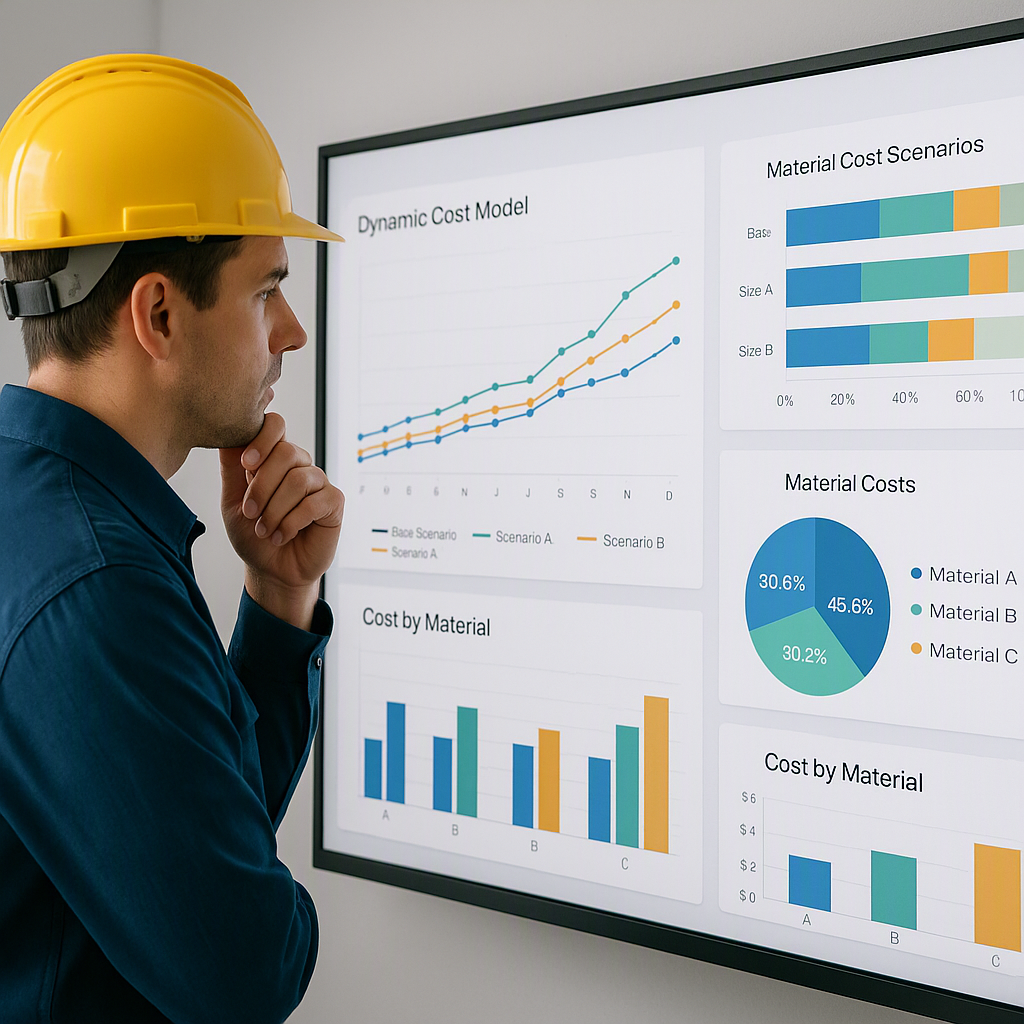
Every estimate is a prediction, and predictions come with risks. What happens if material prices increase or project specifications change? Traditional tools like spreadsheets make it cumbersome to test such scenarios. Modern software can help you model these scenarios efficiently.
Actionable Steps:
- Adopt dynamic estimation software: Platforms like CostOS allow you to adjust rates, quantities, or inflation factors in real time, giving you a clearer picture of potential outcomes.
- Model multiple scenarios: Develop best-case, worst-case, and likely-case projections. This ensures your team is prepared for fluctuations in costs or schedules.
- Use historical trends: Analyze past price variations to better predict future changes. For instance, if steel prices have historically risen 5% annually, factor this into your estimates for long-term projects.
- Present scenarios to stakeholders: Transparent communication about potential risks and contingencies builds trust and demonstrates thorough planning.
5. Normalize Subcontractor Bids
Comparing subcontractor bids is a critical but tedious task. It involves matching scopes, identifying exclusions, and ranking quotes. A structured approach to bid leveling can reduce errors and ensure fair comparisons.
Actionable Steps:
- Standardize bid templates: Provide subcontractors with a detailed form that standardizes scope and pricing. This reduces the risk of omitting key cost components.
- Use bid leveling software: Platforms like BuildingConnected can automate bid comparisons, flag discrepancies, and highlight areas needing clarification.
- Audit exclusions: Carefully review exclusions in subcontractor bids to avoid surprises later. Common exclusions include permits, overtime, or specific materials.
- Engage in open communication: Clarify ambiguous terms or scope discrepancies with subcontractors before making a final decision.
6. Factor in Inflation and Regional Adjustments
Inflation and regional cost variations are significant factors in construction estimation. Material prices, labor wages, and transportation costs can fluctuate, impacting project budgets.
Actionable Steps:
- Regularly update rate databases: Use inflation indices like the Consumer Price Index (CPI) or Producer Price Index (PPI) to adjust pricing for materials and labor.
- Apply regional multipliers: Account for variations in taxes, labor costs, and transportation expenses. For example, projects in urban areas may have higher labor costs but lower transportation expenses.
- Monitor commodity trends: Track key material prices like steel, concrete, and lumber for accurate forecasting. Websites like TradingEconomics or government reports can provide valuable insights.
- Plan for contingencies: Allocate a specific percentage of your budget for inflation and unexpected cost increases. This cushion can prevent cost overruns.
7. Consider the Real ROI of Estimation Tools
Investing in estimation tools can seem costly upfront, but the long-term benefits often outweigh the initial expense. These tools save time, improve accuracy, and enable estimators to respond to more bids, potentially increasing revenue.
Actionable Steps:
- Evaluate costs vs. benefits: Compare the tool’s subscription fees against potential savings in time and error reduction. Perform a cost-benefit analysis to justify the investment.
- Look for scalability: Ensure the tool can handle projects of varying sizes and complexities. For example, a tool that works for both residential and commercial projects offers greater versatility.
- Test usability: Select platforms with intuitive interfaces to minimize training time. Request demos or trial periods to assess their ease of use.
- Measure ROI post-implementation: Track metrics like bid turnaround time, accuracy rates, and win rates to evaluate the tool’s impact on your operations.
Common Mistakes to Watch For
- Over-reliance on gut instinct: Estimation should be data-driven, not based on guesswork.
- Ignoring regional factors: Small differences in labor rates or taxes can significantly impact margins.
- Skipping audit trails: Without proper documentation, disputes and renegotiations can become challenging.
- Underestimating inflation: Failing to account for rising costs can lead to underbidding.
- Not testing scenarios: Changes in timelines or specifications can derail projects if not accounted for in advance.
Learn more at JobNext.ai - Construction ERP
Put this into a real cost estimate
Describe your project and get a complete, costed estimate in about a minute — free to start.