



BOQ Abstract Example: A Practical Guide for Construction Estimators
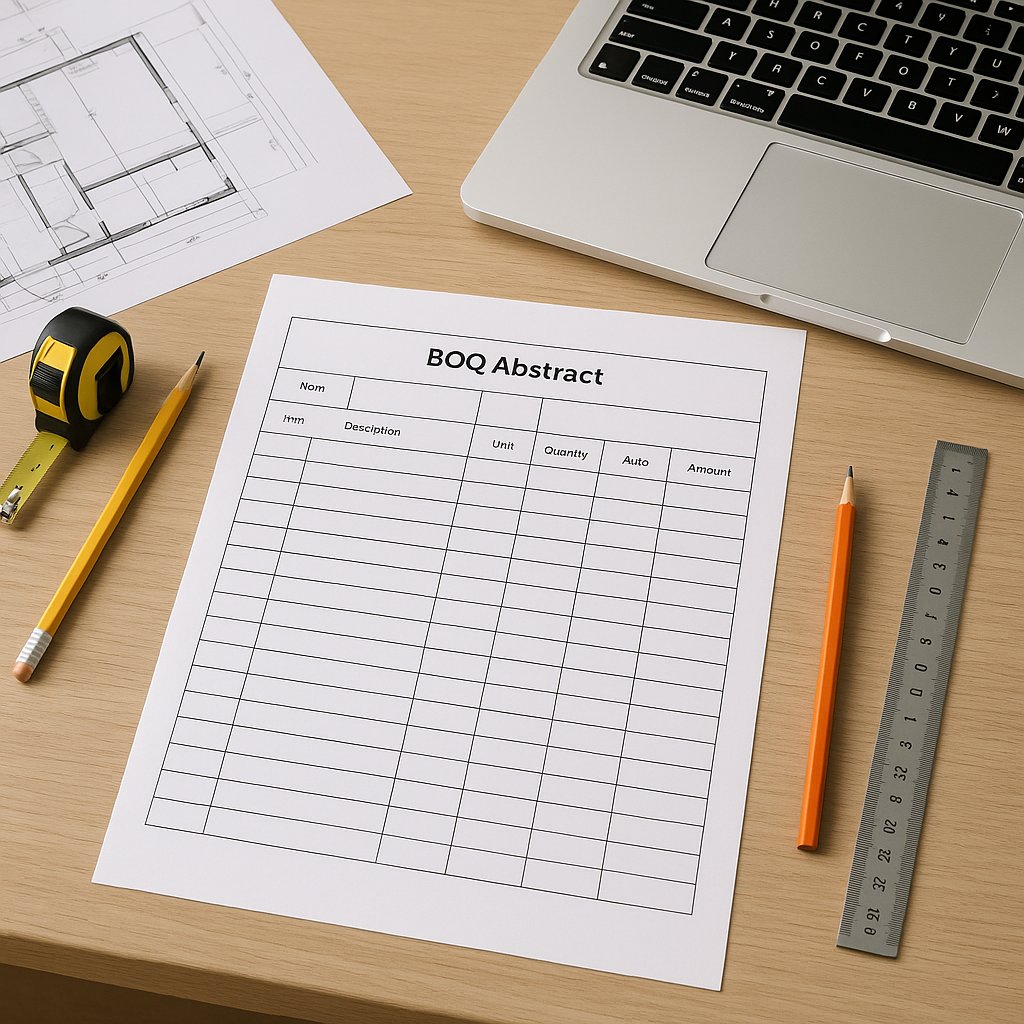
BOQ Abstract Example: A Practical Guide for Construction Estimators
Let’s be real—building a Bill of Quantities (BOQ) can feel like pulling teeth. You’ve got endless line items, rates to look up, and quantities to double-check. One missed detail? You’re eating into your margins or worse, losing the bid entirely.
But here’s the kicker: most BOQs fail not because we lack skills, but because we waste time on repetitive tasks that could be streamlined. That’s where a well-structured BOQ abstract comes in. Done right, it can save significant time and eliminate costly errors.
What’s a BOQ Abstract?
In simple terms, a BOQ abstract is the summary sheet that consolidates all the detailed items in your BOQ into major categories. Instead of scrolling through hundreds of rows, you get a high-level snapshot of costs broken down by work sections—like civil works, finishes, MEP, etc. Think of it as your executive summary for the estimate.
Why does this matter? Because clients and directors don’t want to sift through granular details. They want clarity. A concise abstract helps them understand your bid without drowning in data.
The Essentials of a BOQ Abstract
A good BOQ abstract includes:
- Categories: Civil Works, MEP, Finishes, etc.
- Quantities: Total quantities for each category.
- Rates: Unit rates per item or task.
- Subtotals: Cost per category.
- Grand Total: Overall project cost.
- Markup Details: Overheads, profit, and taxes.
Illustrative example — simplify formatting and group totals for clarity:
| Category | Quantity | Unit | Rate | Subtotal |
|---|---|---|---|---|
| Civil Works | 200 sqm | sqm | ₹1,250 | ₹250,000 |
| MEP | 50 units | unit | ₹8,000 | ₹400,000 |
| Finishes | 150 sqm | sqm | ₹1,800 | ₹270,000 |
| Grand Total | ₹920,000 |
Why Most BOQs Fall Apart
Let’s talk common mistakes:
- Overcomplicated Formats: Nested formulas and multi-tab Excel sheets that require a PhD to interpret.
- Rate Mismatches: Pulling outdated rates from PDFs or relying on guesswork.
- Version Chaos: Updates in one section don’t cascade across the document.
- Incomplete Abstracts: Missing markup details or ambiguous categories.
If this sounds familiar, you’re not alone. Many contractors struggle with inefficient templates and manual workflows. The solution? Standardize your structure and explore tools that can assist in automating repetitive tasks.
Using Tools to Simplify BOQ Abstracts
Digital tools can make BOQ preparation faster and less painful. Here’s how they can help:
- Smart BOQ Parsing: Upload your Excel file, and it automatically detects headers, merged cells, and hierarchies.
- Rate Matching: Search across regional SOR items to find rates quickly.
- Real-Time Updates: Adjust a rate or quantity, and the abstract recalculates instantly.
- Output Formats: Export to standardized formats like CSI MasterFormat, CPWD DSR, or NRM2.
For example, if a client asks for fiber-reinforced concrete instead of standard concrete, you can tweak the material rate, and the abstract updates automatically—reducing manual rework.
Step-by-Step BOQ Abstract Preparation
Here’s the workflow we recommend:
- Define Categories: Start with high-level sections like Civil Works, MEP, Finishes.
- Compile Quantities: Use takeoff sheets or digital tools to extract quantities from drawings.
- Match Rates: Pull rates from regional SORs or rate libraries.
- Calculate Subtotals: Multiply quantities by rates and aggregate by category.
- Add Markups: Include overheads, profit, and taxes.
- Format the Abstract: Use clean, professional templates.
Common Questions
1. How do I handle scope changes mid-project?
Linked formulas and adjustable cost factors are key. Digital tools can ensure your BOQ adapts instantly without breaking.
2. What if I’m working across multiple markets?
Use regional rate libraries. Many tools support CPWD DSR for India, RSMeans for the US, and AECOM rates for GCC countries.
3. How do I make my BOQ client-friendly?
Focus on clarity. Include detailed breakdowns, audit trails, and professional formatting.
4. Should I prepare the abstract manually or automate it?
Manual prep is fine for small projects. For larger ones, automation saves time and reduces errors.
5. What output formats are essential?
At a minimum: CSI MasterFormat, CPWD DSR, or NRM2. These ensure compliance and professionalism.
Final Thoughts
A well-structured BOQ abstract isn’t just about saving time—it’s about reducing errors, improving client trust, and winning more bids. If you’re tired of wasting hours on manual prep, consider exploring tools that can simplify the process.
Learn more at JobNext.ai - Construction ERP
Put this into a real cost estimate
Describe your project and get a complete, costed estimate in about a minute — free to start.