


How AI-Enhanced BOQ Templates Improve Construction Efficiency
How AI-Enhanced BOQ Templates Improve Construction Efficiency
Creating a Bill of Quantities (BOQ) isn't as simple as downloading an Excel file and filling in numbers. The process is complex, time-consuming, and prone to errors. Fortunately, AI-enhanced BOQ templates are changing the game, improving efficiency and accuracy in construction projects.
The Turning Point: AI in Construction
In the past, manual processes dominated the creation of BOQs. Construction professionals spent countless hours on tasks like drawing takeoffs, leading to errors and inefficiencies. However, AI tools like EstimateNext have revolutionized this process. By utilizing Vision AI, these tools drastically reduce the time spent on manual takeoffs—from hours to minutes. This isn't just a marketing gimmick; it's a real efficiency booster.
Actionable Steps to Implement AI Tools
-
Evaluate Your Current Process: Determine how much time and resources you're spending on manual BOQ tasks. This will help you quantify the benefits of switching to AI and identify specific areas where AI can have the most impact.
-
Research AI Solutions: Look for AI tools that specialize in construction and BOQ management. Evaluate features, user reviews, and cost. Consider factors such as user interface, scalability, and support services.
-
Trial and Training: Use free trials to test the software. Ensure your team receives adequate training to maximize the tool's potential. This can involve workshops, online tutorials, and real-time support to address any learning curves.
-
Integration: Ensure the AI tool integrates seamlessly with existing systems like project management software. This ensures that data flows smoothly between different platforms, reducing the need for duplicate entries and minimizing errors.
-
Monitor and Adjust: After implementation, continuously monitor the performance of the AI tool. Gather feedback from users to make necessary adjustments and improvements.
Why the Old Ways Persisted
Despite the advantages of AI, many professionals stick to traditional methods. Familiarity with Excel and a fear of change often outweigh the potential benefits of new technologies. In high-stakes construction projects, the mantra "better the devil you know" often prevails.
Overcoming Resistance to Change
-
Start Small: Implement AI tools in small projects first to showcase benefits without overwhelming the team. This allows for a controlled environment to test the software's capabilities and demonstrate its value.
-
Highlight Success Stories: Share examples of successful AI implementation within the industry. This can be done through case studies, webinars, or industry conferences where peers can share their experiences.
-
Provide Continuous Support: Offer ongoing training and support to ease the transition. This can involve dedicated support teams, regular check-ins, and feedback loops to ensure users are comfortable and confident in using the new tools.
-
Incentivize Adoption: Offer incentives such as bonuses or recognition programs for teams that successfully transition to AI-enhanced processes.
The Shift: Embracing AI-Enhanced BOQ Templates
Integrating AI into BOQ processes offers numerous advantages. Tools like EstimateNext enhance accuracy by matching rates across a vast catalog of items. When you adjust a rate in a BOQ, the AI updates changes in real-time, complete with an audit trail. This saves hours and minimizes errors from manual recalculations.
Steps for Integration
-
Upload Your BOQ: Start by uploading your existing Excel or CSV files to the AI platform. The AI will handle cell merging, section headers, and hierarchies automatically, saving you from tedious manual formatting.
-
Rate Analysis: AI breaks down costs into material, labor, and equipment, providing a comprehensive audit trail for each rate. This allows for more transparent and accountable cost estimations.
-
Semantic Search: Find the correct rates without sifting through pages of PDFs using semantic search features. This enhances the speed and accuracy of finding relevant data.
-
Real-Time Adjustments: AI allows for instantaneous changes, propagating through the entire BOQ, ensuring consistency and accuracy. This feature significantly reduces the risk of human error and ensures that all stakeholders are working with the most up-to-date information.
The Cost of Being Wrong
Relying on outdated methods can lead to significant losses. Slow processes result in missed bids, and errors in BOQs can cost thousands or even millions. Additionally, manual tasks strain estimators, who spend late nights tracing PDFs instead of focusing on strategic tasks.
Reducing Errors and Costs with AI
-
Error Detection: AI tools automatically detect and correct errors, reducing costly mistakes. This not only saves money but also enhances the credibility of your estimations.
-
Efficiency Gains: Faster processes mean more bids can be submitted, increasing chances of winning projects. By streamlining workflows, teams can focus on more strategic areas such as client relations and project planning.
-
Stress Reduction: Automating mundane tasks allows estimators to focus on high-value activities. This not only improves job satisfaction but also enhances productivity and creativity.
Customizing Your BOQ Template
Utilizing AI doesn't mean abandoning Excel. You can start with a basic Excel template and integrate AI features to enhance functionality.
Customization Steps
-
Template Upload: Upload your Excel template to the AI platform. The system will automatically recognize and organize your data, setting the stage for enhanced analysis.
-
AI Integration: Use AI to analyze and break down costs, ensuring accurate rate calculations. This involves linking your template with AI-driven databases and analytics tools.
-
Real-Time Updates: Adjust rates and watch changes propagate instantly. This ensures that everyone involved in the project is on the same page and working with the latest figures.
-
Compliance Checks: Ensure compatibility with local standards and regulations. This feature is particularly useful for projects spanning multiple regions with different compliance requirements.
Adapting BOQ Templates for Different Markets
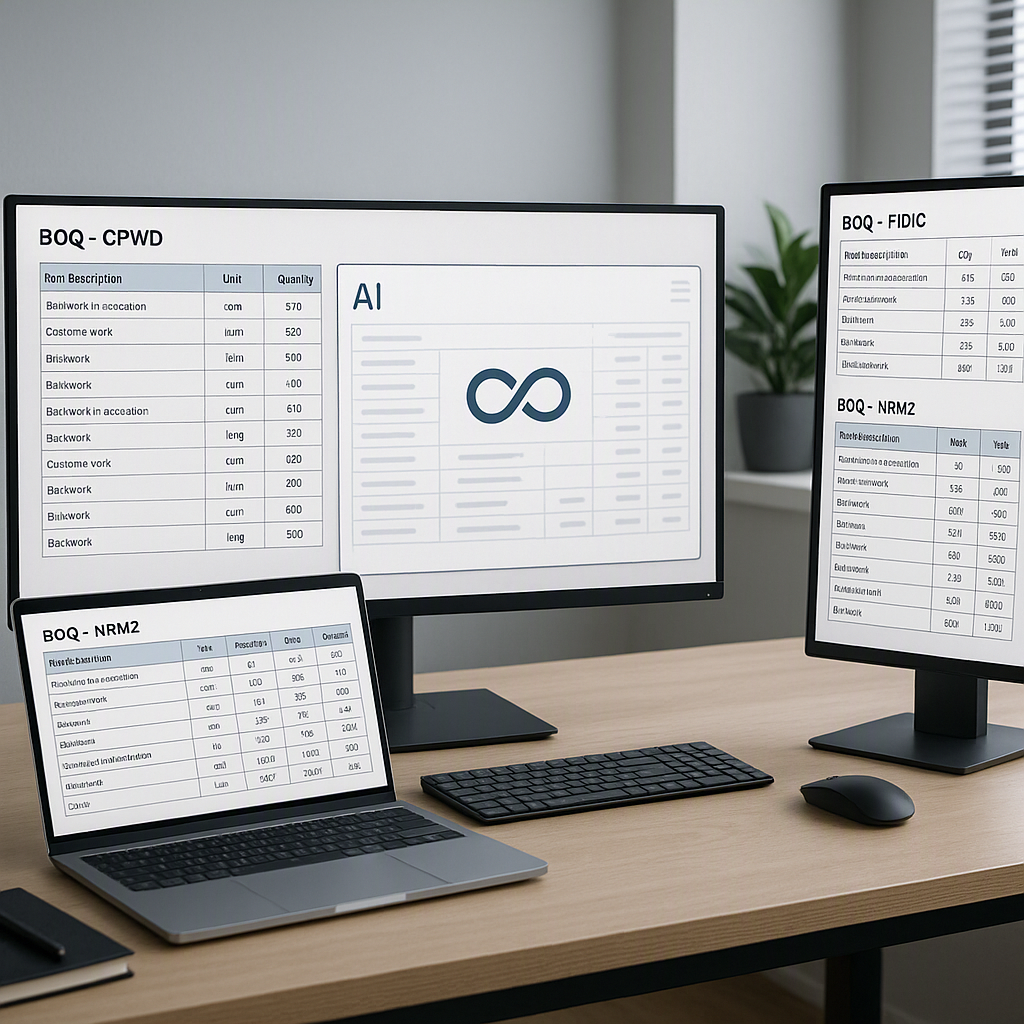
Construction standards vary by market, whether it's CPWD compliance in India or FIDIC standards in the GCC. AI tools help adapt BOQ templates by offering multi-country rate options and compliance checks.
Market-Specific Adaptation
-
Multi-Country Rate Options: AI tools provide rate options tailored to specific markets. This allows for more accurate and competitive bidding across different regions.
-
Compliance Checks: Automated checks ensure adherence to local standards. This feature minimizes the risk of penalties or project delays due to non-compliance.
-
Localization Features: Adapt templates for local languages and units of measurement. This ensures that all stakeholders, regardless of location, can understand and work with the BOQ efficiently.
The Future of BOQ Templates with AI
AI will continue to refine and enhance BOQ processes with more integration possibilities, predictive analytics, and compliance features. As AI evolves, expect faster and more accurate estimates, driving even greater efficiency in construction projects.
Future Trends
-
Predictive Analytics: AI will offer predictive insights, helping project managers anticipate and mitigate potential risks before they become issues.
-
Integration with IoT: AI tools will increasingly integrate with IoT devices on construction sites, providing real-time data and insights that can further enhance BOQ accuracy.
-
Enhanced Collaboration: AI platforms will offer enhanced collaborative features, allowing teams across different locations to work together seamlessly.
FAQ
1. Can I use AI tools with any BOQ template?
Yes, AI tools can integrate with standard Excel templates to enhance functionality without requiring a complete overhaul of your existing systems.
2. Does AI handle different measurement standards?
Absolutely. AI platforms like EstimateNext manage various standards like CSI, NRM2, and CPWD, ensuring that your BOQs are compliant with regional norms.
3. How does AI improve rate accuracy?
By accessing a vast catalog of SOR items and offering real-time rate adjustments, AI tools ensure that your estimates are as accurate and competitive as possible.
4. Is AI suitable for small projects?
Yes, AI can scale and is beneficial for projects of any size, offering cost and time efficiencies that can be particularly valuable for smaller teams.
5. What if I need to adjust the BOQ for different markets?
AI tools provide multi-country rate options, making it easy to adapt to local standards and ensuring your bids are competitive across different regions.
Conclusion: Maximizing Efficiency with AI-Powered BOQ Tools
Incorporating AI into BOQ templates isn't just about saving time; it's about increasing accuracy and reducing the stress of manual entries. If you're dealing with these inefficiencies, EstimateNext can help. Get started free →
Learn more at JobNext.ai - Construction ERP
Put this into a real cost estimate
Describe your project and get a complete, costed estimate in about a minute — free to start.