


How AI Solutions Address Construction Cost Estimation Challenges
Overcoming Construction Cost Estimation Challenges with AI Solutions
In the world of construction, managing project costs accurately is crucial. Yet, traditional estimation methods often fall short, causing delays, budget overruns, and strained client relationships. If you've been in the industry long enough, you've probably faced the nightmare of an underestimated project. Let's talk about how AI-powered tools are changing the game.
The Persistent Challenges in Construction Cost Estimation
Construction cost estimation is riddled with challenges. Normally, getting an accurate estimate involves multiple layers of data—man-hours, materials, machinery, and more. All of these need to be precise for a project to stay on budget. But, as RIB Software notes, unexpected changes and data transfer errors are common pain points.
Understanding Traditional Challenges in Detail
-
Data Inaccuracies and Errors: Manual data entry is prone to errors. Human oversight might miss small discrepancies that can lead to significant financial consequences. These errors often arise from miscommunication, outdated information, or simply human fatigue.
-
Market Volatility: According to RSMeans, unpredictable market conditions can throw a wrench in even the best-laid plans. The cost of materials, labor, and equipment can fluctuate due to economic shifts, political instability, or unforeseen global events, making it nearly impossible to predict costs accurately without advanced tools.
-
Complex Regulatory Environments: Different regions have varying laws and standards which can complicate estimation processes. Not adhering to these can result in legal consequences. Inconsistent compliance can lead to fines, project delays, and damage to company reputation.
Actionable Steps to Address Traditional Challenges
-
Data Compilation: Ensure your data is comprehensive and up-to-date. Consider digitalizing your data collection process to minimize errors. Use cloud-based solutions to centralize data access and updates. Regular audits and checks should be conducted to maintain data integrity.
-
Regular Market Analysis: Keep an eye on market trends to anticipate cost changes. Subscribe to industry reports and use historical data analytics to predict future trends. Employ software that provides real-time updates on material costs and labor rates.
-
Risk Management: Develop a risk management plan to handle unexpected changes effectively. This includes setting aside a contingency budget and regularly reviewing project milestones. Conduct scenario planning to prepare for various potential market conditions.
The Role of AI in Revolutionizing Cost Estimation
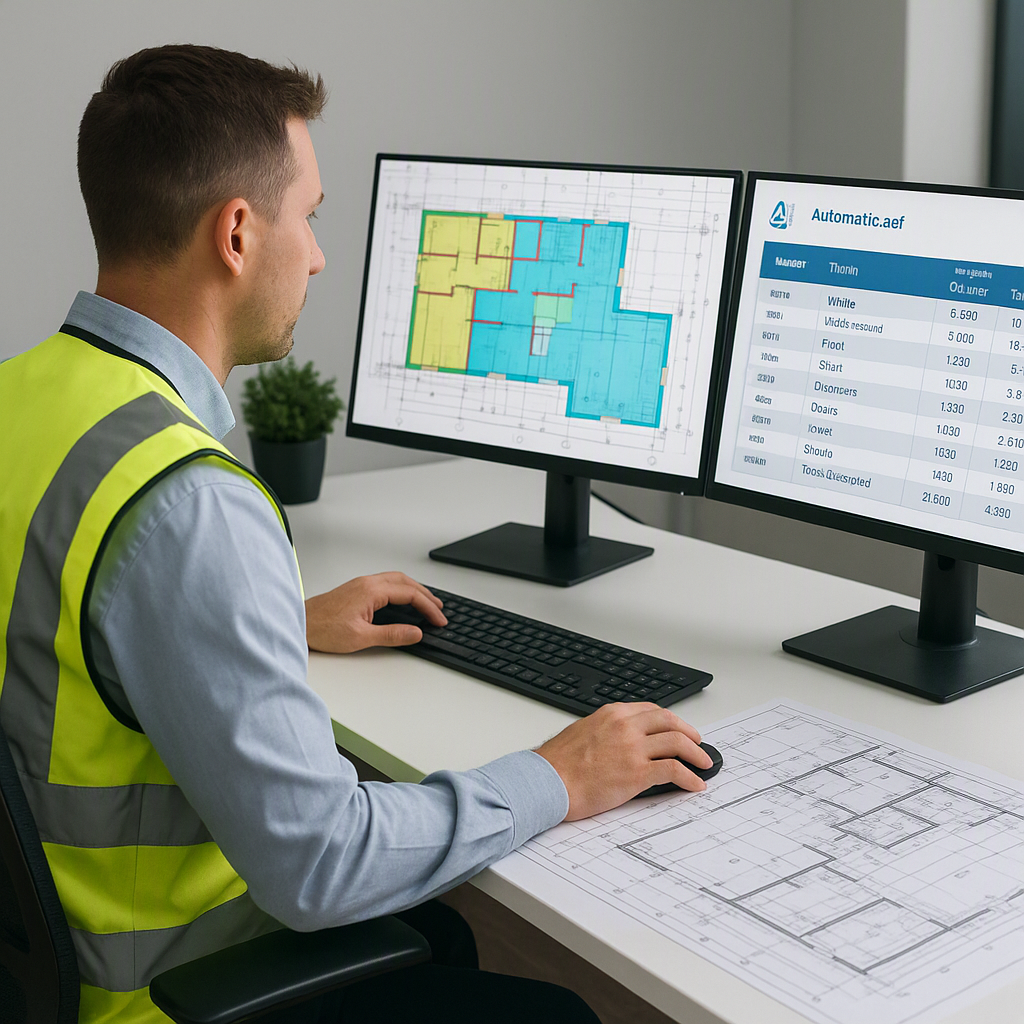
AI technologies offer a fresh approach to these age-old problems. By leveraging AI, construction firms can improve accuracy and efficiency. AI tools can significantly reduce takeoff times and eliminate human error in rate matching.
How AI Enhances Accuracy
-
Automated Takeoffs: AI can extract quantities from PDFs or drawing sets much faster than manual methods. Tools like PlanSwift and Bluebeam use machine learning to automate these processes, reducing human errors. These tools not only speed up the estimation process but also increase accuracy by eliminating manual measurement errors.
-
Predictive Modeling: AI can analyze historical data to predict future costs, providing a more accurate estimation than static data methods. This involves using algorithms to identify patterns and trends that are not immediately visible to human analysts. Predictive models can also simulate different scenarios to forecast potential cost impacts.
-
Error Reduction: By automating repetitive tasks, AI minimizes human error, allowing estimators to focus on complex decisions. AI systems can also validate data entries against known benchmarks to catch anomalies early in the process.
Actionable Steps for Implementing AI in Estimation
-
Select the Right Tools: Choose AI tools that integrate well with your existing systems and have a proven track record in the industry. Evaluate tools based on ease of integration, user-friendliness, and customer support.
-
Training and Development: Invest in training your team to ensure they are fully capable of using AI tools to their full potential. Provide ongoing education opportunities to keep staff updated with the latest AI developments.
-
Continuous Improvement: Regularly update your AI models with new data to improve accuracy over time. Implement a feedback loop where estimators can report discrepancies and suggest improvements.
Addressing Multi-Market Complexity with AI Tools
Estimating costs across different regions can be a daunting task. Each region may have different measurement standards, currencies, and tax regimes. AI tools simplify this complexity through a unified platform.
Unified Platform Benefits
-
Standardization: AI ensures that estimations adhere to local standards and regulations automatically, reducing the risk of non-compliance. It can automatically adjust calculations based on regional differences in codes and practices.
-
Currency Conversion: Real-time currency conversion tools integrated with AI platforms allow for accurate cross-border cost estimations. This is particularly useful for multinational construction firms working on global projects.
-
Compliance Checks: AI can automatically check for compliance with local laws, reducing the risk of legal issues. This feature saves time and resources that would otherwise be spent on consulting local experts for every project.
Actionable Steps for Multi-Market Estimation
-
Integrate Local Data Sources: Use AI tools that allow integration with local data sources for accurate regional data. This helps in understanding local market conditions better.
-
Set Up Automated Alerts: Configure AI systems to alert you to changes in regional regulations or economic conditions that could affect costs. This proactive approach can help adjust project plans before any significant impact.
Real-Time Data Integration for Accurate Estimation
Incorporating real-time data into the estimation process is essential for accuracy. Traditional methods rely on static data, which can quickly become outdated.
Steps for Effective Real-Time Integration
-
API Integration: Use APIs to connect your estimation tools with real-time data sources such as market databases and stock inventories. This ensures that your data is always current and relevant.
-
Continuous Monitoring: Set up alerts for significant market changes to adapt your estimates promptly. This allows for quick adjustments in project budgets and timelines, reducing the risk of unexpected costs.
-
Data Validation: Regularly validate the data being fed into the system to ensure its accuracy. Implement protocols for data quality checks to maintain the integrity of your estimations.
Evaluating the ROI of AI-Powered Estimation Tools
When it comes to AI-powered tools, ROI is a critical factor for decision-makers. AI tools can save significant time and resources, offering a compelling return on investment.
Evaluating ROI
-
Time Savings: AI tools can perform complex calculations in seconds, freeing up human resources for other tasks. This efficiency translates into faster project completion times and the ability to handle more projects simultaneously.
-
Cost Reduction: By improving accuracy, AI reduces the risk of budget overruns and costly errors. This leads to more predictable project costs and better financial planning.
-
Competitive Advantage: Faster, more accurate estimates can lead to more competitive bids and increased win rates. Companies using AI tools can often offer more competitive pricing due to efficiency gains.
Actionable Steps for ROI Evaluation
-
Benchmarking: Compare pre- and post-AI implementation metrics to assess improvements. Track key performance indicators such as estimation accuracy, project completion times, and cost savings.
-
Cost-Benefit Analysis: Conduct a thorough cost-benefit analysis to evaluate the long-term savings and benefits of AI tools. Consider both direct financial impacts and indirect benefits such as improved client satisfaction.
Conclusion: The Future of Construction Cost Estimation
The construction industry is on the brink of a transformation, and AI is at the forefront. AI-powered tools are not just a luxury; they are becoming a necessity for competitive success. As we move forward, these tools will continue to evolve, offering even more sophisticated solutions to the challenges that have plagued the industry for decades.
If you're dealing with construction cost estimation challenges, exploring AI solutions can be a beneficial step.
FAQ
Q: How accurate are AI-powered estimates compared to manual ones?
AI tools are highly accurate, often reducing takeoff discrepancies significantly. However, accuracy depends on the quality of input data, so human oversight is still essential.
Q: Can AI tools work for smaller projects?
Absolutely. AI tools scale to any project size, whether you’re handling a small renovation or a large infrastructure project. They adjust their processes to suit the scope and complexity of the project.
Q: What’s the ROI for investing in AI estimation tools?
AI tools can offer substantial cost savings and efficiency improvements, making them a worthwhile investment. The ROI is often seen in reduced project timelines and fewer budget overruns.
Q: Are AI tools difficult to learn?
Most platforms are designed for ease of use, with intuitive interfaces. Training typically takes a short period, and many tools offer comprehensive support resources.
Q: Can AI help with subcontractor coordination?
Yes, AI tools can streamline the process of normalizing sub bids and ranking, making coordination more efficient. They facilitate better communication and collaboration among project stakeholders.
Comparison Table: Traditional vs. AI-Powered Estimation Methods
| Feature | Traditional Estimation | AI-Powered Estimation |
|---|---|---|
| Accuracy | Subject to human error | High accuracy, data-driven |
| Time Efficiency | Time-consuming | Fast and automated |
| Cost Management | Prone to overruns | Better control and prediction |
| Data Handling | Manual data entry | Real-time data integration |
| Scalability | Limited | Easily scalable |
| Multi-Market Compatibility | Complex and manual | Simplified and automated |
This comprehensive approach to understanding AI in construction cost estimation provides a clear picture of how these technologies are reshaping the industry, making it more efficient and competitive.
Learn more at JobNext.ai - Construction ERP
Put this into a real cost estimate
Describe your project and get a complete, costed estimate in about a minute — free to start.