


Why You’re Wasting Time Without a Target Cost Solver in Construction Estimation
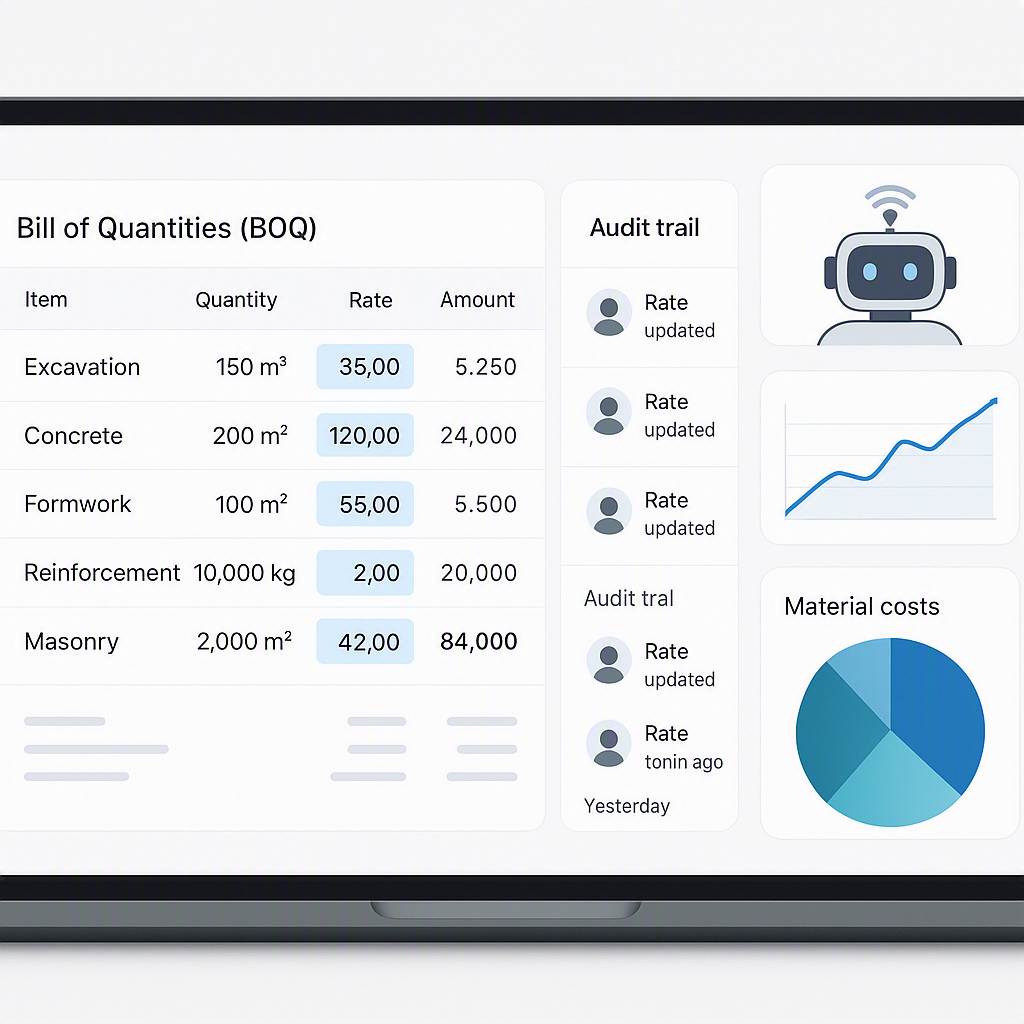
I Used to Trust Spreadsheets for Cost Estimation — Until I Tried a Target Cost Solver
I used to think spreadsheets and rate books were all you needed for construction cost estimation. After all, that's how we've been doing it for decades, right? You get a BOQ (Bill of Quantities), update your rates manually, apply some markup, and hope it all adds up. If the client pushes back, you either trim down your profit or start playing the guessing game with cheaper materials. It's a time-consuming grind, but it seemed like the only way to get the job done.
Then I came across a tool that changed everything: a target cost solver. I'll admit, when I first heard about it, I was skeptical. How could a tool do what experienced estimators had been doing for years? But one project forced me to see things differently.
The Wake-Up Call
It was a large office fit-out project—one of those high-stakes bids where the client had already set a tight budget ceiling. We had to work backward to hit the target cost while keeping the scope intact. This wasn't a simple "cut here, trim there" situation. It was more like fitting a square peg into a round hole—every adjustment we made to labor costs or materials affected other parts of the project. After three days of back-and-forth with my team and several late nights, we finally submitted our bid.
Spoiler: we didn't win. Worse, we later found out the winning bid came in $50,000 lower than ours with the same scope. How? They had used an AI-powered estimation tool with a target cost solver. That's when I decided to dig deeper.
Why the Old Way Lasted So Long
At first, I couldn't figure out why we'd stuck with the old method for so long. I mean, we've known for years that spreadsheets are prone to errors. I've lost count of how many times a misplaced formula or an outdated rate has caused headaches. But the thing is, we trusted what we knew. The tools we had—Excel, Bluebeam for takeoffs, and RSMeans for rates—felt reliable. They were familiar.
And let's be honest: the construction industry isn't exactly quick to embrace change. There's always this undercurrent of, "If it isn't broken, don't fix it." Except, it was broken. We just didn't realize how much it was costing us.
Common Problems with Traditional Methods
-
Human Error: A 2015 study by Market Watch found that 88% of spreadsheets contain errors. When you're dealing with complex BOQs and tight deadlines, a simple typo in a formula can have massive consequences.
-
Time Consumption: Traditional estimation processes often involve manually inputting data, cross-checking rates, and double-checking calculations. This can take days—or even weeks—for large projects.
-
Lack of Flexibility: Spreadsheets don't easily adapt to changes. If a client asks for an updated estimate mid-project, you're often left scrambling to adjust rates and quantities, re-checking every cell to ensure nothing breaks.
-
Data Silos: Tools like Excel or Bluebeam often operate in isolation. You might have to manually transfer data between platforms, which increases the risk of errors and slows down the process.
What a Target Cost Solver Actually Does
A target cost solver flips the entire estimation process on its head. Instead of starting with quantities and rates and then figuring out the total cost, you start with the client's budget. The solver works backward, optimizing material specifications, labor, and overhead to fit within that budget while maintaining quality.
How It Works
Here’s a breakdown of how a target cost solver operates:
- Input Parameters: You enter the project details—such as scope, client budget, material preferences, and labor rates—into the tool.
- Optimization: The solver analyzes thousands (or even millions) of combinations of materials, labor configurations, and overhead scenarios to find the most cost-effective options that still meet your project requirements.
- Real-Time Adjustments: As you tweak variables (e.g., swapping materials or adjusting labor hours), the tool recalculates the impact instantly, giving you immediate feedback.
- Output Options: Instead of providing a single estimate, the tool offers a range of solutions tailored to different priorities—whether it's minimizing costs, maximizing quality, or meeting a specific deadline.
Example Application
Imagine you're bidding on a 10,000-square-foot office fit-out. The client has a budget of $800,000. Traditional estimation would involve building up the cost from a BOQ, tweaking rates and materials until you (hopefully) land close to the target. But with a target cost solver, the tool evaluates thousands of combinations of materials, labor rates, and design options in seconds. It suggests the best way to meet the $800,000 target without sacrificing the project's requirements.
EstimateNext is one of the leading platforms offering target-cost solvers. Their tool doesn’t just generate numbers—it provides actionable insights. For instance, you can test:
- How swapping imported Italian marble for local tiles impacts cost.
- Whether reducing labor hours could free up budget for higher-quality fixtures.
- The cost implications of using alternative suppliers.
What I Do Differently Now
Since discovering this feature, I’ve made a few key changes:
-
Reduced Reliance on Spreadsheets: While Excel is still useful for smaller jobs, I've stopped relying on it for complex projects. The risk of errors and inefficiencies is just too high.
-
Adopted AI Tools: Tools like EstimateNext now handle the heavy lifting. I upload the BOQ, specify the client’s budget, and let the AI do the math. This saves hours of manual effort and leaves me more time to focus on strategy.
-
Client-Centric Approach: I start every estimation process with the client’s budget in mind. Instead of working from the bottom up, I work backward from their constraints. This shift in mindset has helped me create more competitive bids.
-
Faster Turnarounds: With AI tools, I can generate estimates in minutes instead of days. This speed has allowed me to respond to bid requests faster and win more projects.
Decision Framework: Manual vs. AI-Powered Estimation
| Criteria | Manual Estimation | AI-Powered Estimation |
|---|---|---|
| Time Required | Days to weeks | Minutes to hours |
| Risk of Errors | High (human error in formulas, data) | Low (if data input is accurate) |
| Flexibility for Changes | Limited (manual rework required) | High (real-time recalculations) |
| Cost Optimization | Inconsistent (depends on estimator skill) | Consistent (algorithm-driven) |
| Data Integration | Poor (tools operate in silos) | High (integrates multiple data sources) |
Final Thoughts
Looking back, sticking to the old way cost me more than just one lost bid. It cost my team time, energy, and morale. Nobody likes staying late to wrestle with spreadsheets, only to lose a bid due to a small mistake or lack of optimization.
If your team is still stuck in the slow lane of manual estimation, it’s time to rethink your tools. EstimateNext offers an AI-powered target cost solver that can save you time, improve accuracy, and help you win more bids. Give it a try today!
Learn more at JobNext.ai - Construction ERP
Put this into a real cost estimate
Describe your project and get a complete, costed estimate in about a minute — free to start.