



BOQ Automation Advantages: Saving Time, Reducing Errors, and Boosting ROI
Why Manual BOQs Are Slowing You Down
Let’s face it—manual BOQs (Bills of Quantities) are a bottleneck. If you’re still using Excel or flipping through rate books, you know the pain. Every project starts from scratch. Rates are scattered across PDFs, and every change means recalculating totals, row by row. It’s tedious. Worse, it’s error-prone. Forget one rate or miscalculate a quantity and suddenly your bid is off significantly.
And that’s not all. According to a 2023 McKinsey report, poor productivity in construction costs the industry $1.6 trillion globally every year. A significant chunk of this comes from manual processes like traditional BOQs. But there’s good news: automation tools are changing the game.
The Problem with Traditional BOQs
1. Time Drain
Manual BOQ preparation can take significant time, especially for mid-size contractors. Tasks like tracing drawings, matching rates, and recalculating totals are labor-intensive and time-consuming.
2. Error-Prone Calculations
Manually linking rates to quantities invites mistakes. A single typo—or worse, a formula error—can cascade into inflated costs or underbidding.
3. No Reuse, No Intelligence
Why do we start every project from scratch? Your previous estimates are goldmines of useful data. Yet, traditional workflows rarely allow reuse. Each BOQ feels like reinventing the wheel.
4. Client Rework Takes Forever
Need to adjust for a client’s “what-if” scenario? With manual BOQs, this means redoing the entire thing. Every change ripples across the sheet and demands a full audit.
How BOQ Automation Solves These Problems
Automation tools for BOQs are designed to eliminate these headaches. Here’s how automation makes a difference:
1. Faster Rate Matching
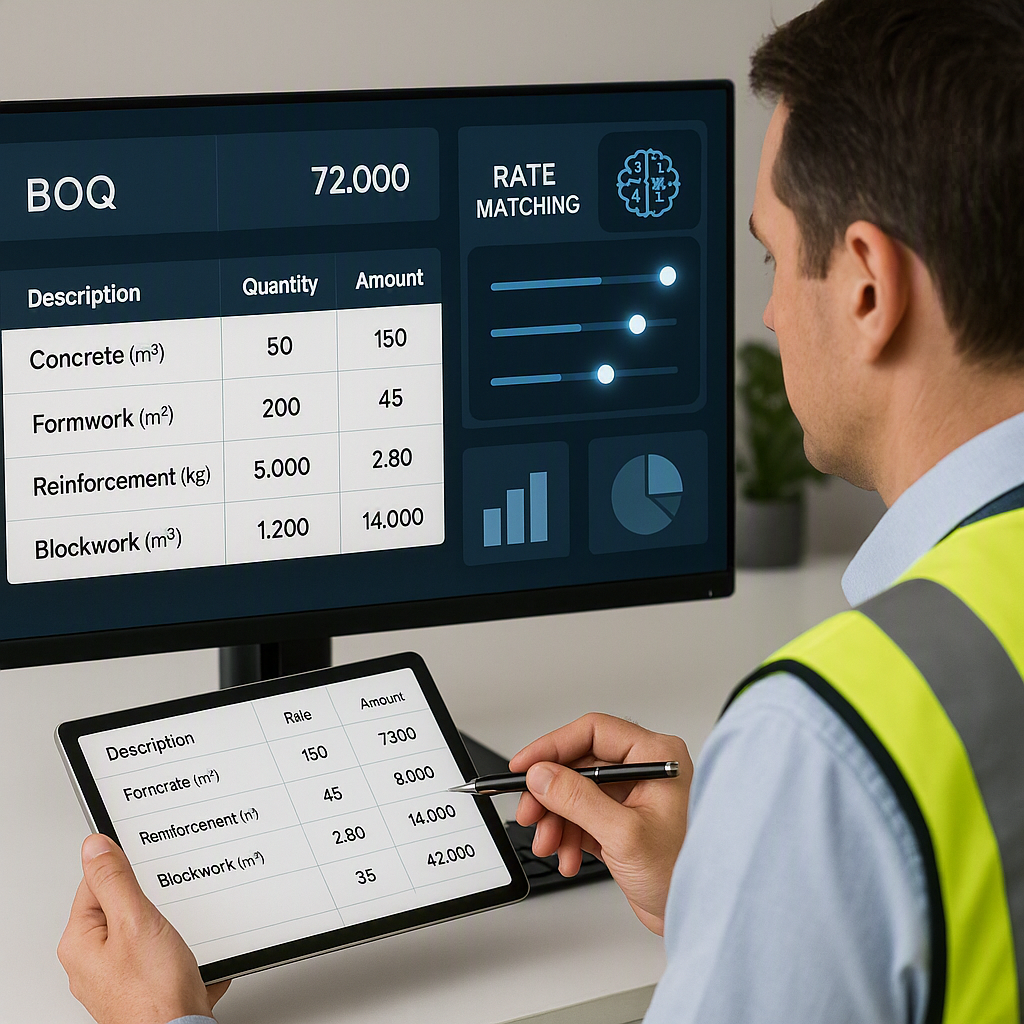
With traditional methods, matching line items to rates can take hours. Automation tools use advanced search capabilities to quickly match items to rates, even when descriptions vary. This significantly reduces the time spent on this task.
2. Instant Updates Across Your BOQ
Changing one rate in a manual BOQ often means recalculating every linked formula. Automation tools allow you to adjust a rate, and the system propagates that change across the entire BOQ instantly. This feature saves time and ensures accuracy.
3. Error Reduction with Automated Checks
Automation reduces human error by auto-matching rates and quantities. It can also flag inconsistencies for review, ensuring your bid is accurate and reliable.
4. Built-In Intelligence for Better ROI
Automation tools can store and learn from past projects, recommending rates that have worked well before. They can also factor in variables like inflation, regional indices, and labor trends to keep your estimates competitive and accurate.
Illustrative Example: Commercial Fit-Out
Imagine you’re pricing a large commercial office fit-out. Traditionally, you might:
- Start with a blank BOQ template.
- Spend hours entering quantities, flipping through rate books, and fixing formulas.
- Redo the entire sheet for a single change request.
With a BOQ automation tool, the process is streamlined:
- Upload the BOQ file (Excel, CSV, or even PDF).
- The tool parses sections, quantities, and line items automatically.
- AI matches most rates instantly, leaving only a small portion for manual adjustment.
- Any changes are propagated across the BOQ in real-time, saving you hours.
Why does this matter? Faster turnaround times mean you can submit more bids, with fewer errors, and improve your chances of winning work.
Common Questions About BOQ Automation
Q1: Is automation reliable for custom BOQs?
Yes, but not perfect. Automation tools often use a combination of historical rates, user-defined catalogs, and regional data to match items. While some manual review may still be needed, the overall effort is significantly reduced.
Q2: Can BOQ automation handle scope changes?
Absolutely. Linked formulas and adjustable cost factors ensure your BOQ adapts instantly to changes without breaking. This is critical for client-friendly workflows.
Q3: Does automation replace my rate book?
No, it enhances it. Automation tools act as a smart layer on top of your existing rate book, making your data faster, smarter, and easier to use.
Q4: Is setup complicated?
Not at all. Most tools are designed to be user-friendly. If you can upload a BOQ file and click “match,” you’re ready to go.
What to Watch For
- Overdependence on Automation: Don’t skip manual reviews entirely. Automation is powerful, but human oversight catches edge cases.
- Catalog Completeness: Ensure your tool's rate library covers your specific market (e.g., CPWD DSR for India, RSMeans for the US).
- Training Time: Tools learn from your inputs. Invest some effort upfront for smoother workflows later.
The Bottom Line
Manual BOQs are holding you back. Automation tools save time, reduce errors, and improve ROI—not by replacing your expertise, but by amplifying it. If you’re tired of wasting hours on repetitive tasks and rework, it’s time to try something better.
Learn more at JobNext.ai - Construction ERP
Put this into a real BOQ
Describe your project and get a complete, costed Bill of Quantities in about a minute — free to start.