



Why Real-Time Rate Propagation in BOQs Changed How We Estimate Costs
What We Used to Think About BOQs
For years, we believed updating Bills of Quantities (BOQs) was just part of the job. You open Excel, comb through rate books, make changes line by line, and hope nothing breaks. It’s tedious, sure, but that’s construction estimation, right? Every estimator I worked with saw this as unavoidable.
But here’s the thing: it wasn’t just tedious—it was risky. One overlooked cell could throw off the entire bid. That one error could result in underpricing or overpricing a project, potentially costing a company thousands or even millions. Fixing errors wasn’t quick either. If a client requested a what-if scenario, you’d spend hours reworking formulas and recalculating totals. There was no audit trail to track changes, and no guarantees that your numbers were accurate.
This manual process also made collaboration difficult. If multiple estimators worked on the same BOQ, reconciling changes or catching duplicate errors became a logistical nightmare.
What Changed My Mind: Real-Time Propagation
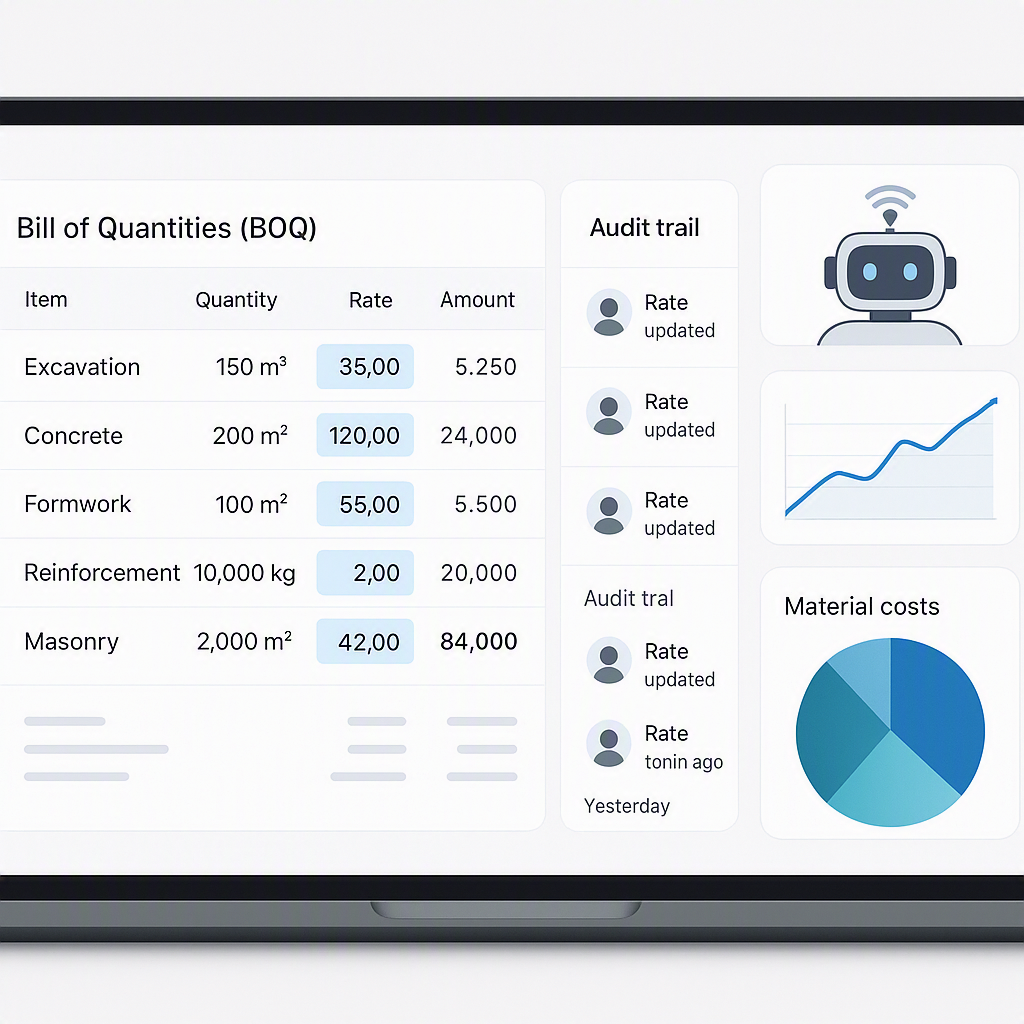
Everything shifted when I saw EstimateNext handle a BOQ change in seconds. Imagine this: you adjust the rate for reinforced concrete in a 50,000 sq. ft. office fit-out. Instead of manually recalculating every line item, the system propagates the update across the entire BOQ instantly. No broken formulas, no missed totals, no manual rechecking.
EstimateNext’s documentation explains how their AI-powered BOQ engine works. Rates are stored in a centralized library, matched to line items automatically, and updated in real time. The audit trail lets you see every change—who made it, when, and why. It’s like having a second pair of eyes on your estimate at all times.
This wasn’t just a cool feature; it fundamentally changed how we approach estimation. Real-time propagation eliminated the need for repetitive, error-prone manual work. It also gave us confidence that our bids were accurate and aligned with updated rates.
Why Real-Time Propagation Matters
To understand the impact, consider the ripple effects of a single rate change. Let’s say the cost of steel increases by 5%. In a manual system, you’d have to adjust every line item that includes steel, then verify that the totals in each section are correct. If you miss even one line, your entire bid could be off. Real-time propagation eliminates this risk by automating the update process.
Additionally, the audit trail is a game-changer for accountability. If a client questions your numbers or requests a breakdown, you can instantly show them when and why a rate was adjusted, along with its impact on the final total.
Why We Stayed Stuck for So Long
I think the old way stuck around because it felt safer. Manual work gave you control—you could see every cell, double-check every formula. But control isn’t the same as accuracy. In fact, manual updates make mistakes more likely, not less. Human error is inevitable, especially when you’re dealing with thousands of line items.
Plus, we underestimated just how much time was being wasted. A 2023 McKinsey report found that poor productivity costs the construction industry $1.6 trillion annually, much of it tied to manual processes like BOQs. That’s real money being drained from projects, and much of it is preventable.
Another reason we stayed stuck was fear of change. Many estimators worried that automation would threaten their jobs or require them to learn complex new systems. But as we've since learned, the right tools don’t replace expertise—they enhance it.
What We Do Differently Now
Now, we use tools designed for real-time rate propagation. The process looks like this:
-
Upload the BOQ: Whether it’s in Excel, CSV, or PDF format, the system parses everything into sections, quantities, and line items. This eliminates tedious data entry.
-
Rate Matching: AI matches rates from a preloaded catalog, factoring in material, labor, and equipment costs. In our experience, about 85% of rates are matched automatically. For the remaining 15%, manual review ensures accuracy for complex or unique items.
-
Adjust Rates: Need to tweak a rate? Just update it, and the system handles the rest. For example, if labor costs increase, you update the hourly rate, and every affected line item is recalculated instantly.
-
Review Changes: The audit trail shows how the update impacts totals, keeping everything transparent. This is particularly useful when presenting estimates to clients or management.
-
Export and Share: Once finalized, exporting the BOQ into various formats is easy, allowing seamless collaboration with stakeholders.
It’s not flashy, but it works. A 40-hour estimate now takes under 8 hours.
Additional Benefits
- Improved Collaboration: Multiple estimators can work on the same BOQ without stepping on each other’s toes. Changes are tracked in real time.
- Error Reduction: Automation drastically reduces the risk of calculation errors.
- Scenario Modeling: You can test multiple what-if scenarios in minutes, helping clients make informed decisions.
What We’re Still Figuring Out
There’s a learning curve. For smaller firms, switching to AI-powered tools might feel intimidating. The upfront cost and time investment can be a barrier. Not every BOQ fits neatly into a digital system—custom projects sometimes need manual overrides.
However, the ROI is hard to ignore. A general contractor (GC) team pricing five GMP pursuits a year saves 200+ hours annually, according to EstimateNext’s case studies. Those hours translate into dollars, freeing up resources for higher-value activities like client engagement or project management.
Comparison Table: Manual vs. AI-Powered BOQ Updates
| Aspect | Manual Process | AI-Powered Process |
|---|---|---|
| Time Required | 20–40 hours per estimate | 4–8 hours per estimate |
| Error Risk | High (due to human oversight) | Minimal (automated calculations) |
| Collaboration | Difficult (manual reconciliation) | Easy (real-time updates) |
| Scenario Modeling | Time-consuming | Instant |
| Transparency | Limited (no audit trail) | Full audit trail |
| Cost of Errors | Potentially high | Significantly reduced |
FAQ
Q: Can this handle international projects?
Yes. Tools like EstimateNext support country-specific catalogs (e.g., CSI, CPWD, CESMM3) and adjust for local currencies, taxes, and labor rules. This makes them suitable for projects across different regions.
Q: What if a rate isn’t in the catalog?
You can manually input rates for unique line items. The AI also learns from your adjustments, improving accuracy for future projects. This hybrid approach ensures flexibility without sacrificing efficiency.
Q: How accurate is the rate matching?
Most line items are matched automatically, but around 15% might need manual review based on complexity. Accuracy depends on the quality of your preloaded catalog and the uniqueness of the project.
Q: Will this replace estimators?
No. It’s a tool to make estimators faster, not obsolete. You still need expertise to handle exceptions, interpret client needs, and finalize bids. Automation handles the grunt work; you focus on strategy.
Q: Is it worth the cost?
For GCs and subcontractors dealing with multiple bid packages, the time savings alone justify the investment. The reduced error risk and improved collaboration are icing on the cake.
Call to Action
If you’re tired of wasting hours manually updating BOQs, tools like EstimateNext can help. Get started free →
Learn more at JobNext.ai - Construction ERP
Put this into a real BOQ
Describe your project and get a complete, costed Bill of Quantities in about a minute — free to start.